
About 37.5 inches of precipitation a year, mostly in winter
Concrete Contractors in Crestline, CA
Steps, steep driveways and patios for wet winters and hillside lots in the San Bernardino Mountains.
- Free on-site estimates with a soil and drainage check
- Written, itemized quote before any work starts
- Compacted base, set thickness and planned joints on every pour
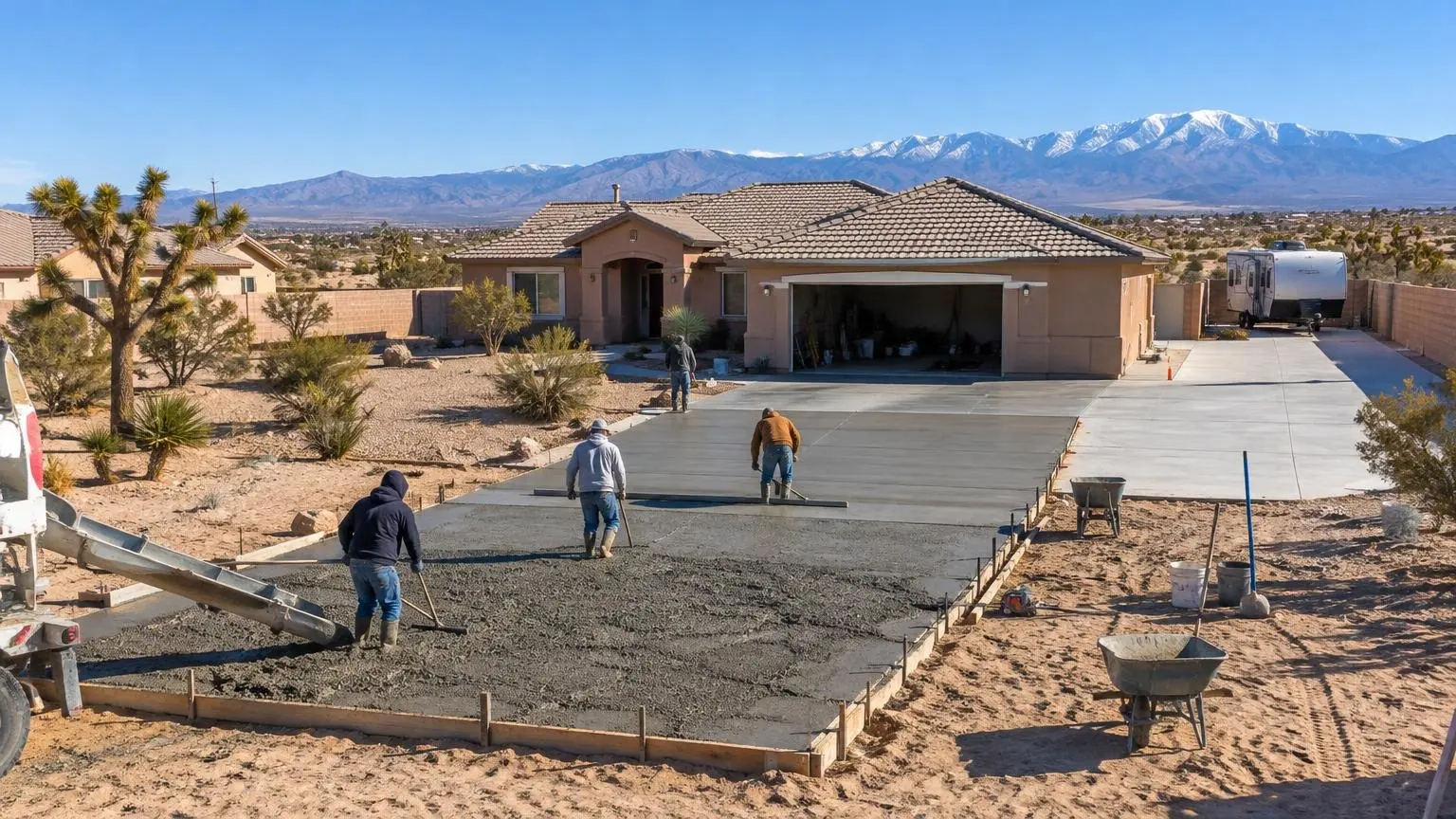
Rain, Frost and Hillside Lots
Crestline sits at about 4,613 feet in the San Bernardino Mountains, inside the San Bernardino National Forest, and its climate table averages roughly 37.5 inches of precipitation annually, about six times Hesperia's total, with the heaviest months in December through March and almost nothing in summer. January lows average 28°F. Concrete contractors working here plan every job around two things that break concrete in the mountains: running water and freezing nights.
Start with where the water goes
On a hillside lot, winter storms send water downhill fast, and it will find the weakest edge of a driveway or the bottom of a stair. Before we price a Crestline job, we walk the lot during the estimate and look at:
- Where runoff enters the property from uphill and where it leaves.
- Whether a curb, swale or trench drain is needed to steer it.
- Whether the base under the existing slab has already washed out.
- Where downspouts discharge relative to walks, steps and the foundation.
Only then do we set slopes and edges, so water leaves the concrete without tunneling under it.
Then build for frost
With January lows below freezing, every exterior slab here is a freeze-thaw slab. That means an air-entrained mix, no added water at the truck, a proper cure before the first hard freeze and a sealer on colored or stamped surfaces. For the first winter, sand is the safer choice for traction; salt accelerates scaling on young concrete.
Steps carry a lot of weight here
Because so many Crestline homes sit above or below the street, the stairs and landings are often the most important concrete on the lot. Old steps tend to heave, crack at the nosings and pull away from the house after decades of frost. A rebuild should have footings on firm ground, risers of equal height, a slight pitch on each tread so water runs off, a broom finish for grip, and an isolation joint where the steps meet the house. If the stairs are part of an engineered stair or retaining wall, we build to that plan.
Year-round residents and seasonal owners
Crestline had 7,306 housing units at the 2020 census, and on census day 2,344 of them (32.1%) were empty, which reflects the seasonal and second homes in the area. QuickFacts puts owner occupancy at 76.3%, and 90.7% of residents had not moved in the past year. Full-time residents usually want a driveway they can trust every winter morning. Seasonal owners usually want problems fixed while they are away, with photos as the work goes.
Around Lake Gregory
Lake Gregory lies in Crestline proper. Work started in 1937, when a Works Progress Administration grant paid to dam the east and west forks of Houston Creek. The project wrapped up in January 1939 with a road, today's Lake Drive, built across the dam. The water sits at 4,554 feet. Heavy March rains in 1938 filled it in about three days. Homes on the lower ground near the lake and its creeks see that same storm runoff, so drainage around patios and drives gets extra attention there.
Fire history
In late October 2003 the Old Fire swept across 91,281 acres. Crestline was among the mountain resort towns it threatened, along with Cedar Glen, Running Springs and Lake Arrowhead, until it was fully contained on November 2. Many mountain owners now use concrete to reduce what can burn next to the house, swapping wood steps and decks near the walls for concrete and setting propane tanks and firewood on slabs.
Getting concrete up the hill
Narrow, winding streets and steep driveways decide how concrete gets delivered. Where a mixer cannot reach or safely park, we plan a pump. Most Crestline pours are scheduled for the drier, warmer months so fresh concrete is not caught by a storm or a hard freeze.
Crestline Facts
- Wet winters. Annual precipitation near 37.5 inches, concentrated from December to March; average January low 28°F.
- Seasonal homes. Of 7,306 housing units counted in 2020, 2,344, or 32.1%, were vacant on census day.
- Long-term owners. Owner-occupied rate 76.3%; 90.7% of residents at the same address one year earlier (Census QuickFacts).
- Lake Gregory. Started in 1937 with WPA money to dam Houston Creek's east and west forks; finished in January 1939. Surface elevation: 4,554 feet.
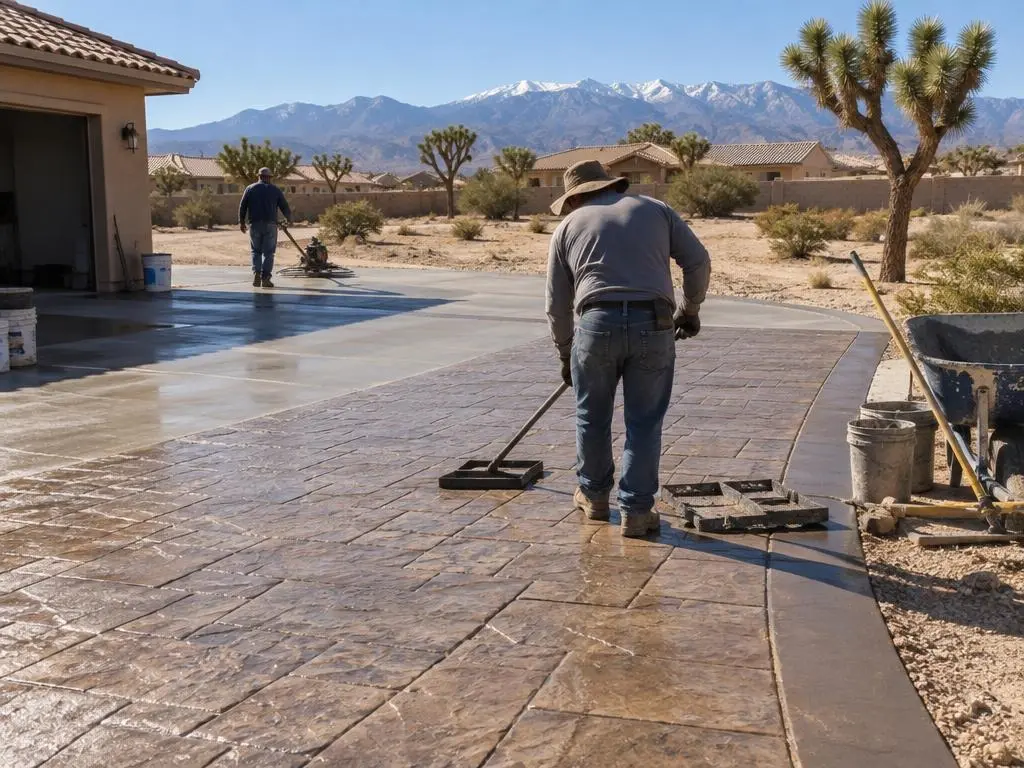
Our Services in Crestline, CA
Crestline Questions
Why do my front steps keep cracking?
Usually frost heave and water. Steps without footings on firm ground, or with water pooling at their base, move every winter. A rebuild needs footings, drainage and air-entrained concrete.
Can you pour a driveway on a steep lot?
Yes. We use a deeper broom texture for grip, plan drainage so runoff does not undercut the edges, and bring in a pump when a mixer cannot reach.
When do you pour in Crestline?
Mostly in the drier, warmer months. Winter storms bring both heavy rain and freezing nights, and fresh concrete should see neither.
Free Estimates in Crestline, CA
Have steps, a driveway or a patio in Crestline that needs work? Request a free estimate.
Concrete Contractors Near Crestline
- Concrete Contractors in Hesperia, CA
- Concrete Contractors in Victorville, CA
- Concrete Contractors in Apple Valley, CA
- Concrete Contractors in Adelanto, CA
- Concrete Contractors in Oak Hills, CA
- Concrete Contractors in Spring Valley Lake, CA
- Concrete Contractors in Phelan, CA
- Concrete Contractors in Pinon Hills, CA
- Concrete Contractors in Mountain View Acres, CA
- Concrete Contractors in Lucerne Valley, CA
- Concrete Contractors in Helendale, CA
- Concrete Contractors in Wrightwood, CA
- Concrete Contractors in Lake Arrowhead, CA
- Concrete Contractors in Running Springs, CA
- Concrete Contractors in Devore, CA
- Concrete Contractors in Lytle Creek, CA
- Concrete Contractors in Muscoy, CA
- Concrete Contractors in San Bernardino, CA
- Concrete Contractors in Highland, CA