
Long called the Southern Portal of the Cajon Pass
Concrete Contractors in Devore, CA
Driveways, patios and repairs for foothill homes where I-15 starts the climb toward Hesperia.
- Free on-site estimates with a soil and drainage check
- Written, itemized quote before any work starts
- Compacted base, set thickness and planned joints on every pour
At the Bottom of the Pass
Devore sits at the foot of the Cajon Pass, about 12 miles northwest of downtown San Bernardino, and residents long called it the Southern Portal of the Cajon Pass. It is a rural residential neighborhood of the city of San Bernardino, just north of where Interstate 15 and Interstate 215 meet. For concrete contractors coming down the pass from Hesperia, it is a short drive, but the ground, the wind and the fire history here are very different from the desert floor.
Built on flood and fault ground
The foothills around Devore are made of alluvial flows. The San Andreas Fault runs through the hills at the upper end of the community, and the Glen Helen and San Jacinto faults run through Cajon Creek and Cajon Wash below it. For flatwork, that geology shows up in three ways:
- Mixed soil. Alluvium can hold sand, gravel and cobbles in the same hole. Loose pockets and voids around rocks cause uneven settling, so we dig out soft material and compact a uniform base.
- Storm water. Canyons and washes carry runoff during storms, so slope and drainage need careful planning.
- Ground movement. With faults nearby, reinforcement matters. Steel will not stop a crack, but it keeps the pieces level and together.
A town that once made its own cement
Devore has an unusual tie to the trade. According to its Wikipedia entry, Portland cement was shipped from Europe until about 1904, so early residents mined calcite and made their own building materials in local kilns. Writers of the time praised the homes, rock walls and gardens John Devore built into the community, and residents still value privacy and a rural lifestyle. The kilns in the Kimbark Canyons were especially useful in those years. Rock walls and stone-edged gardens are still part of the look of many Devore lots, so when we pour a new walk or patio next to one, we keep an isolation gap at the wall and match the grade so water does not pond against the stone.
Fire and flood history
The Old Fire in 2003 burned 91,281 acres; Devore's Wikipedia entry counts 940 homes, 30 commercial buildings and 300 outbuildings lost across the fire, and the area had earlier been through the Panorama Fire of November 1980, which burned 23,800 acres. Much of what John Devore built was destroyed by the Flood of 1938. Both lessons apply to concrete. Noncombustible walks, patios and pads near the house cut down on what can burn, and every sloped driveway needs a plan for where storm water crosses it, whether a crown, a swale or a culvert.
Wind down the pass
Santa Ana winds are channeled through the Cajon Pass in autumn and, in extreme cases, approach 60 mph. Wind like that can dry the surface of fresh concrete before it is finished. We schedule pours for calm days, set up wind breaks where practical and start curing immediately after finishing.
Driveways for rural lots
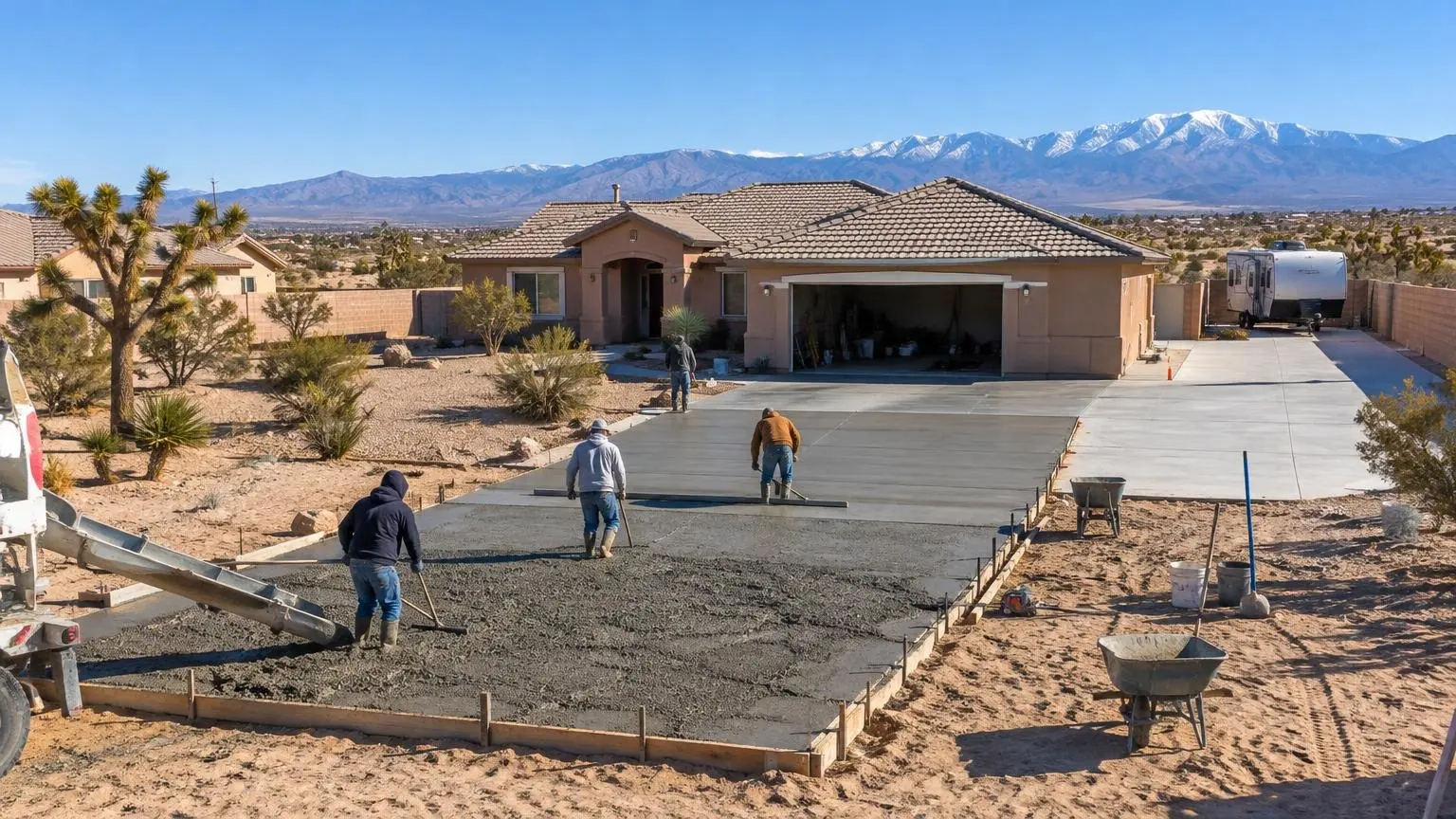
Devore lots often have long drives, gates and room for trailers or horse rigs. That use needs more than a standard car driveway. We size the thickness and steel for the heaviest vehicle, thicken the edges where wheels run close to them and use a broom finish that grips on a grade. Where the drive crosses a natural drainage path, we build in a swale or culvert so water passes without undercutting the slab.
City rules
Because Devore is part of the city of San Bernardino, city rules cover work in the street, sidewalk and driveway approach. We check with the City of San Bernardino about permit requirements for any right-of-way work before scheduling.
Devore Facts
- Portal of the pass. A rural neighborhood of San Bernardino about 12 miles northwest of downtown, just north of the I-15 and I-215 junction.
- Faults and alluvium. Its foothills are alluvial flows; the Glen Helen and San Jacinto faults run below it and the San Andreas runs through the hills above.
- Old Fire, 2003. The Old Fire burned 91,281 acres; Devore's Wikipedia entry lists 940 homes, 30 commercial buildings and 300 outbuildings destroyed.
- Early local cement. Portland cement came from Europe until about 1904, so early residents mined calcite and made building materials in local kilns.
Our Services in Devore, CA
Devore Questions
Is Devore under city or county rules?
Devore is a neighborhood of the city of San Bernardino, so city rules cover street and sidewalk work. We confirm permit needs with the city before scheduling.
How do you pour on rocky ground?
We dig out loose material and voids around cobbles, compact a uniform base and add base rock where needed, so the slab bears evenly.
Can concrete help with fire safety?
It does not burn, so walks, patios and pads near the house can replace bark, wood decking and other combustible materials.
Free Estimates in Devore, CA
Live in Devore? Ask for a free estimate on your driveway, patio or slab.
Concrete Contractors Near Devore
- Concrete Contractors in Hesperia, CA
- Concrete Contractors in Victorville, CA
- Concrete Contractors in Apple Valley, CA
- Concrete Contractors in Adelanto, CA
- Concrete Contractors in Oak Hills, CA
- Concrete Contractors in Spring Valley Lake, CA
- Concrete Contractors in Phelan, CA
- Concrete Contractors in Pinon Hills, CA
- Concrete Contractors in Mountain View Acres, CA
- Concrete Contractors in Lucerne Valley, CA
- Concrete Contractors in Helendale, CA
- Concrete Contractors in Wrightwood, CA
- Concrete Contractors in Crestline, CA
- Concrete Contractors in Lake Arrowhead, CA
- Concrete Contractors in Running Springs, CA
- Concrete Contractors in Lytle Creek, CA
- Concrete Contractors in Muscoy, CA
- Concrete Contractors in San Bernardino, CA
- Concrete Contractors in Highland, CA