
A city of 99,818 that grew from 4,592 in 1970
Concrete Contractors in Hesperia, CA
Driveways, patios, slabs and repairs planned for fine sandy desert soil, 100-degree summers and winter nights near freezing.
- Free on-site estimates with a soil and drainage check
- Written, itemized quote before any work starts
- Compacted base, set thickness and planned joints on every pour
Concrete Work in Our Home City
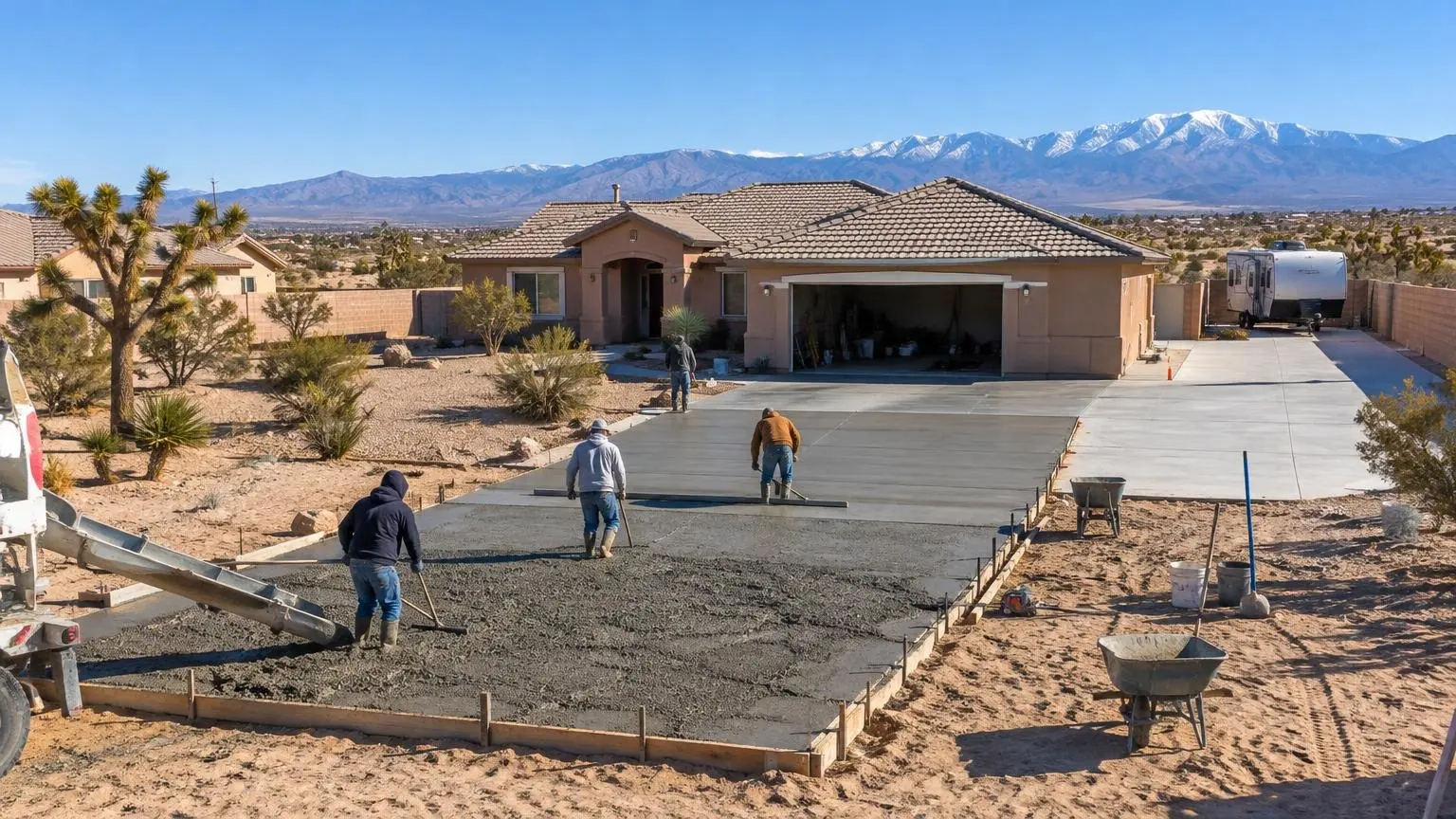
Hesperia is our home city, and the concrete contractors work we do here starts with the ground. Much of the town sits on long, gentle alluvial fans that rise from about 3,200 feet in the north to roughly 4,000 feet toward the south. The soil series that carries the city's name, Hesperia fine sandy loam, is described by the USDA as well drained with moderately rapid permeability. That is good news for drainage and less good news for a lazy base, because loose sand shifts if it is not compacted before a pour.
How the city filled in
In the early 1950s, developer M. Penn Phillips and boxer Jack Dempsey paid for roads and subdivisions and sold lots on television. The real wave came later. Hesperia had 4,592 residents in 1970, 13,540 in 1980 and 50,418 in 1990. The city incorporated on July 1, 1988, and the 2020 census counted 99,818 people in 30,344 housing units. That means a large share of driveways and patios here were poured in the 1980s and 1990s. Slabs of that age often show the same problems: settled sections near the garage, cracks that run off the corners of the slab, and edges that crumble where sprinklers soaked the sand underneath for years.
What the weather does to a slab
Hesperia gets about 6.19 inches of precipitation and 4.4 inches of snow in an average year. Summer highs push toward 100°F, and December and January lows sit around freezing. The climate table lists a record of 116°F and a record low of -1°F. Concrete expands in the heat and shrinks in the cold, so we cut control joints at sensible spacing so the slab cracks where we plan it to instead of at random.
The heat matters on pour day too. Wet concrete loses water fast in dry desert air, and if the surface dries before the slab below it, you get plastic shrinkage cracks and a weak, dusty top. In summer we schedule early starts, dampen the base, and cure the slab with water or a curing compound so it gains strength the way it should. In winter we watch the overnight forecast, since fresh concrete should not freeze before it has set.
Our six services, matched to Hesperia homes
- Concrete driveways: removal and replacement of tired 1980s and 1990s driveways, or widening for an RV or extra car. We grade for drainage toward the street, not the garage.
- Concrete patios: a plain broom finish or colored slab under a cover, sized for the backyard you actually use.
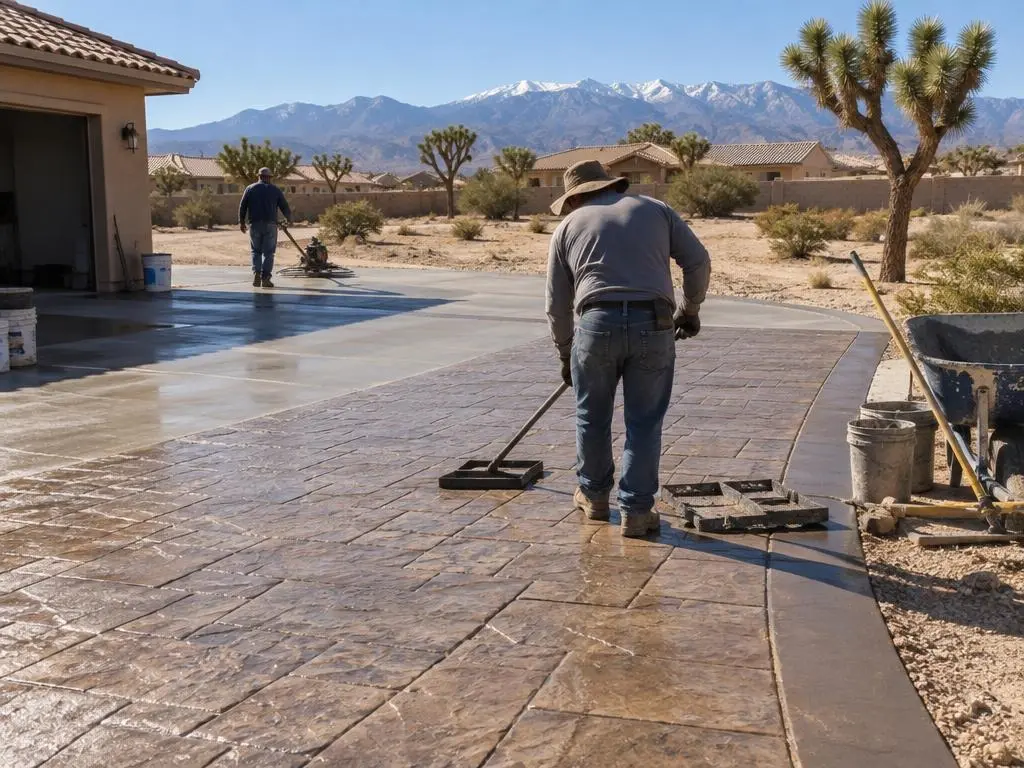
- Stamped concrete: patterns like slate, flagstone or wood plank, with color and a sealer that helps the surface stand up to UV.
- Pool decks: a textured, lighter-toned finish that is easier on bare feet in July, with expansion joints at the coping.
- Concrete slabs: pads for sheds, workshops, carports, equipment and solar inverters, with thickness and reinforcement chosen for the load.
- Concrete repair: crack routing and sealing, sections cut out and replaced, and resurfacing where the base is still sound.
Monsoon storms and runoff
Summer thunderstorms from the North American monsoon can cause local flash floods here, and the usually dry Mojave River on the east side of the city can fill after rare heavy rain. Water that sheets off a roof and across a patio will find any low spot. We set slopes so water moves away from the house, and on bigger slabs we talk about where the runoff lands. During the job we keep washout water and concrete dust out of the gutter. The Mojave River Watershed Group asks homeowners and builders to sweep or scoop cement washout and concrete dust instead of hosing it into driveways, streets or storm drains, and that is how we clean up.
Building near a fault
The San Andreas Fault runs through the Cajon Pass a few miles south of Hesperia and has occasional seismic activity. No slab is earthquake proof, but reinforcement holds cracked pieces together so they do not drift apart and create trip edges. For most driveways and patios we use rebar or welded wire set at mid-depth on supports, not left lying on the dirt where it does nothing.
Lots sold before the roads were finished
The lot sales of the 1950s spread Hesperia out over a lot of ground, and the city filled in unevenly. Today you can find a 1980s tract, a newer subdivision and a custom house on a dirt road within a mile of each other. Each one starts a concrete job from a different place. On a tract lot, the question is usually whether the original thin driveway can be saved. On a custom lot, it is often a first driveway apron, a turnaround or a slab for a shop. Census figures show 65.4% of occupied homes are owner-occupied, so many of these projects are planned by people who intend to stay. If any part of the work reaches the street, the sidewalk or a driveway approach, we check with the City of Hesperia about permits before we put it on the calendar.
Hesperia at a Glance
- Built fast in the 1980s. The population went from 13,540 in 1980 to 50,418 in 1990 and reached 99,818 in 2020, so many driveways and patios are now 30 to 40 years old.
- Fine sandy loam underfoot. The Hesperia soil series, named for the area, is a well-drained fine sandy loam on alluvial fans with moderately rapid permeability.
- Hot days, freezing nights. About 6.19 inches of precipitation and 4.4 inches of snow a year, summer highs near 100°F, and December and January lows around freezing.
- River and aqueduct. The mostly dry Mojave River runs north along the east side, and the California Aqueduct splits the city north to south.
Our Services in Hesperia, CA
Hesperia Questions
Why do so many Hesperia driveways crack at the corners?
Many were poured during the 1980s and 1990s growth years, and corners are where shrinkage and settling stresses meet. Thin sections, missing joints and sand that was never compacted all make it worse. We look at the base and the joint layout before deciding between repair and replacement.
Can you pour concrete in Hesperia in summer?
Yes, with care. We start early in the day, dampen the base, protect the surface from drying too fast, and cure the slab properly so the heat does not leave it weak or full of surface cracks.
Does sandy soil change how you build a patio or driveway?
It means compaction matters. Loose sand settles under load and when water gets into it. We compact the subgrade, add base material where needed, and grade the slab so water drains away instead of soaking the edges.
Free Estimates in Hesperia, CA
Tell us about your Hesperia driveway, patio or slab and we will set up a free on-site estimate.
Concrete Contractors Near Hesperia
- Concrete Contractors in Victorville, CA
- Concrete Contractors in Apple Valley, CA
- Concrete Contractors in Adelanto, CA
- Concrete Contractors in Oak Hills, CA
- Concrete Contractors in Spring Valley Lake, CA
- Concrete Contractors in Phelan, CA
- Concrete Contractors in Pinon Hills, CA
- Concrete Contractors in Mountain View Acres, CA
- Concrete Contractors in Lucerne Valley, CA
- Concrete Contractors in Helendale, CA
- Concrete Contractors in Wrightwood, CA
- Concrete Contractors in Crestline, CA
- Concrete Contractors in Lake Arrowhead, CA
- Concrete Contractors in Running Springs, CA
- Concrete Contractors in Devore, CA
- Concrete Contractors in Lytle Creek, CA
- Concrete Contractors in Muscoy, CA
- Concrete Contractors in San Bernardino, CA
- Concrete Contractors in Highland, CA